


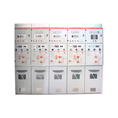

As a supplier of High Distribution Cabinets, I often get asked about the dimensions of a typical High Distribution Cabinet. In this blog post, I'll delve into the various aspects of these dimensions, including standard sizes, factors influencing them, and how they impact the performance and functionality of the cabinet.
Standard Dimensions of High Distribution Cabinets
High Distribution Cabinets come in a range of standard dimensions, but the most common ones are designed to fit into standard electrical rooms and equipment racks. The height of a typical High Distribution Cabinet can vary from around 1.8 meters (70.87 inches) to 2.2 meters (86.61 inches). This height range is chosen to ensure easy access to the internal components while also providing enough space for cable management and ventilation.


The width of a High Distribution Cabinet usually falls between 0.6 meters (23.62 inches) and 1 meter (39.37 inches). A wider cabinet allows for more components to be installed and provides better cable routing options. However, it also requires more floor space.
The depth of the cabinet typically ranges from 0.6 meters (23.62 inches) to 0.8 meters (31.5 inches). A deeper cabinet can accommodate larger components and more complex wiring, but it may also limit the available space in the electrical room.
Factors Influencing the Dimensions
Several factors influence the dimensions of a High Distribution Cabinet. One of the primary factors is the number and size of the electrical components that need to be installed. For example, if the cabinet is designed to house large transformers, circuit breakers, or other heavy-duty equipment, it will need to be larger in size to accommodate these components.
Another factor is the type of installation. Wall-mounted cabinets are generally smaller in size compared to floor-standing cabinets. Wall-mounted cabinets are suitable for applications where space is limited, while floor-standing cabinets are more commonly used in larger electrical rooms.
The ventilation requirements also play a crucial role in determining the dimensions of the cabinet. Adequate ventilation is necessary to prevent overheating of the electrical components. Cabinets with better ventilation may require additional space for vents and fans, which can increase the overall dimensions of the cabinet.
Impact of Dimensions on Performance and Functionality
The dimensions of a High Distribution Cabinet have a significant impact on its performance and functionality. A well-designed cabinet with the right dimensions can ensure proper cable management, efficient ventilation, and easy access to the components.
Proper cable management is essential to prevent cable congestion and reduce the risk of electrical faults. A cabinet with sufficient width and depth allows for easy routing of cables, reducing the chances of cable damage and improving the overall reliability of the electrical system.
Efficient ventilation is crucial to maintain the optimal operating temperature of the electrical components. A cabinet with the right dimensions and ventilation design can help dissipate heat effectively, preventing overheating and extending the lifespan of the components.
Easy access to the components is also important for maintenance and troubleshooting. A cabinet with a suitable height and width allows technicians to easily reach the internal components, making it easier to perform maintenance tasks and diagnose problems.
Specialized Dimensions for Different Applications
In addition to the standard dimensions, High Distribution Cabinets can also be customized to meet the specific requirements of different applications. For example, in industrial settings where high-power distribution is required, cabinets may be designed with larger dimensions to accommodate high-capacity transformers and switchgear.
In data centers, where space is often at a premium, cabinets may be designed with smaller dimensions to maximize the available floor space. These cabinets may also be equipped with advanced cooling systems to ensure the efficient operation of the servers and other equipment.
Importance of Choosing the Right Dimensions
Choosing the right dimensions for a High Distribution Cabinet is crucial for ensuring the efficient and reliable operation of the electrical system. A cabinet that is too small may not be able to accommodate all the necessary components, leading to overcrowding and potential electrical problems. On the other hand, a cabinet that is too large may waste valuable floor space and increase the cost of installation.
When selecting a High Distribution Cabinet, it is important to consider the specific requirements of the application, including the number and size of the components, the available space, and the ventilation requirements. It is also advisable to consult with a professional electrical engineer or a supplier who can provide expert advice on the appropriate dimensions for your specific needs.
Conclusion
In conclusion, the dimensions of a typical High Distribution Cabinet are influenced by several factors, including the number and size of the electrical components, the type of installation, and the ventilation requirements. Choosing the right dimensions is crucial for ensuring the efficient and reliable operation of the electrical system.
If you are in the market for a High Distribution Cabinet, I encourage you to explore our range of products at High Distribution Cabinet. We also offer Distro Power Box and Enclosed Switchgear to meet your specific power distribution needs.
If you have any questions or would like to discuss your requirements further, please feel free to contact us. We are here to help you find the right solution for your electrical system.
References
- Electrical Equipment Handbook: Design and Application by Roger C. Dorf
- Power Distribution Handbook by Clinton W. Fay