


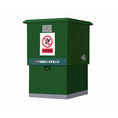

As a supplier of LV Distribution Boxes, I understand the importance of remote control options in modern electrical systems. Remote control not only enhances convenience but also improves safety and efficiency in managing low-voltage distribution. In this blog, I will explore the various remote control options available for an LV Distribution Box and their benefits.
1. Wired Remote Control
Wired remote control systems are one of the most traditional methods for controlling an LV Distribution Box. These systems use physical cables to connect the control device to the distribution box. The main advantage of wired remote control is its reliability. Since the connection is direct, there is no risk of interference from external factors such as radio waves or Wi - Fi signals.
Wired remote control is suitable for applications where the control device is located relatively close to the LV Distribution Box. For example, in a small industrial facility, an operator can use a wired remote to turn on or off specific circuits in the distribution box from a control panel nearby. This method is also often used in situations where high - security is required, as the physical connection makes it difficult for unauthorized access.
However, wired remote control also has some limitations. The installation of cables can be time - consuming and costly, especially in large facilities. Additionally, the distance between the control device and the distribution box is restricted by the length of the cables.
2. Wireless Remote Control
Wireless remote control has become increasingly popular in recent years due to its flexibility and ease of installation. There are several types of wireless technologies that can be used for remote control of an LV Distribution Box.
Radio Frequency (RF) Remote Control
RF remote control uses radio waves to transmit signals between the control device and the distribution box. It offers a relatively long - range communication, typically up to several hundred meters depending on the power of the transmitter and the environment. RF remote control is commonly used in applications where the control device needs to be mobile, such as in a large warehouse or a parking lot.
One of the key benefits of RF remote control is its ability to penetrate through walls and other obstacles. This makes it suitable for use in indoor environments where line - of - sight communication may not be possible. However, RF signals can be affected by interference from other electronic devices, which may cause signal degradation or loss.
Wi - Fi Remote Control
Wi - Fi remote control allows users to control the LV Distribution Box using a Wi - Fi network. This means that the control can be done from any device that is connected to the same Wi - Fi network, such as a smartphone, tablet, or computer. Wi - Fi remote control offers a high - speed and reliable connection, and it also enables remote monitoring and control from anywhere in the world as long as there is an internet connection.
For example, a facility manager can use a smartphone app to check the status of the LV Distribution Box, turn on or off circuits, and receive alerts in case of any abnormalities. However, Wi - Fi remote control requires a stable Wi - Fi network, and security measures need to be in place to prevent unauthorized access.
Bluetooth Remote Control
Bluetooth is a short - range wireless technology that is commonly used for connecting devices such as smartphones and tablets. Bluetooth remote control of an LV Distribution Box is suitable for applications where the control device is in close proximity to the distribution box, typically within a few meters.
The advantage of Bluetooth remote control is its low power consumption and ease of pairing. It is also relatively secure, as the connection is established between two specific devices. However, the short range of Bluetooth limits its use in larger facilities.
3. Internet of Things (IoT) - Enabled Remote Control
The IoT has revolutionized the way we control and monitor electrical systems. An IoT - enabled LV Distribution Box can be connected to the internet, allowing for real - time monitoring and control from a cloud - based platform.


With IoT - enabled remote control, users can access detailed information about the distribution box, such as voltage, current, and temperature. They can also set up automated control rules, such as turning on or off circuits based on time or specific conditions. For example, in a smart building, the LV Distribution Box can be programmed to adjust the lighting and power consumption based on the occupancy of the rooms.
The benefits of IoT - enabled remote control include improved energy efficiency, predictive maintenance, and enhanced safety. However, implementing an IoT - enabled system requires a reliable internet connection and proper security measures to protect the data.
4. Benefits of Remote Control for LV Distribution Boxes
Convenience
Remote control allows users to operate the LV Distribution Box from a distance, eliminating the need to be physically present at the box. This is especially useful in large facilities or in hazardous environments where it may be difficult or dangerous to access the distribution box directly.
Safety
Remote control can improve safety by reducing the risk of electrical shock. Operators can turn off circuits or isolate parts of the distribution box without having to touch the live components. In case of an emergency, such as a short - circuit or over - current, the distribution box can be quickly shut down remotely.
Efficiency
Remote control enables real - time monitoring and control of the LV Distribution Box, which can lead to improved energy efficiency. Users can adjust the power consumption based on the actual demand, reducing waste and saving costs. Additionally, remote control can help in quickly identifying and resolving issues, minimizing downtime.
5. Our Product Offerings
As a supplier of LV Distribution Boxes, we offer a wide range of products with different remote control options. Our Low Voltage AC Switchgear is designed to provide reliable and efficient power distribution. It can be equipped with various remote control systems, including wired, wireless, and IoT - enabled options, to meet the specific needs of our customers.
Our Cable Branch Box is another product that can be remotely controlled. It is used for branching cables in a low - voltage distribution system, and remote control allows for easy management of the cable connections.
We also offer Power Factor Correction Panel with remote control capabilities. These panels are used to improve the power factor of the electrical system, and remote control enables users to monitor and adjust the power factor in real - time.
6. Contact Us for Purchase and Consultation
If you are interested in our LV Distribution Boxes and their remote control options, we invite you to contact us for a detailed consultation. Our team of experts can help you choose the most suitable remote control solution for your specific application. Whether you need a simple wired remote control or a more advanced IoT - enabled system, we have the products and expertise to meet your requirements.
References
- Electrical Power Distribution Handbook, McGraw - Hill
- Wireless Communication Technologies for Industrial Applications, IEEE Publications
- Internet of Things in Electrical Systems: Concepts and Applications, Elsevier